I first encountered it in my parents, my family, my friends’ parents and their families, until it became indistinguishable from what was always propelling me.
When I started studying for the JEE, I felt like I’d found the meaning of life. Really. I would study through the day and evenings, rushing from classes to lab assignments and back home, so, if the day still permitted, I could study more.
Through coaching, I became part of the ‘special batch’ that is formed at the start of every year, based on performance in an internal test that emulates the JEE. Later, when I didn’t do as well on similar tests, I felt dead inside.
I could articulate this inner deadness as a resolution: If there was one thing I couldn’t be, it was stupid.
I couldn’t be stupid. I especially couldn’t be a stupid girl.
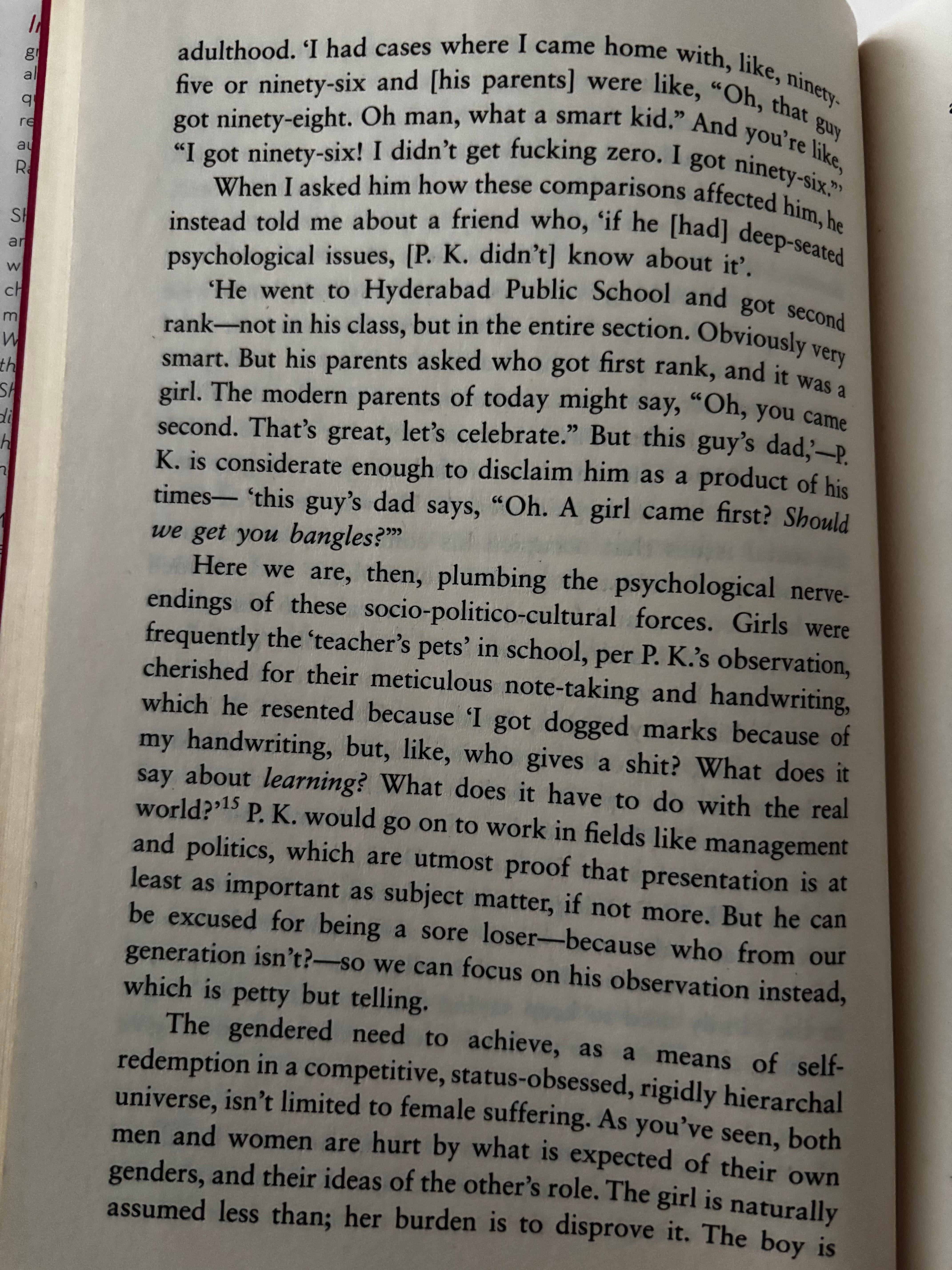
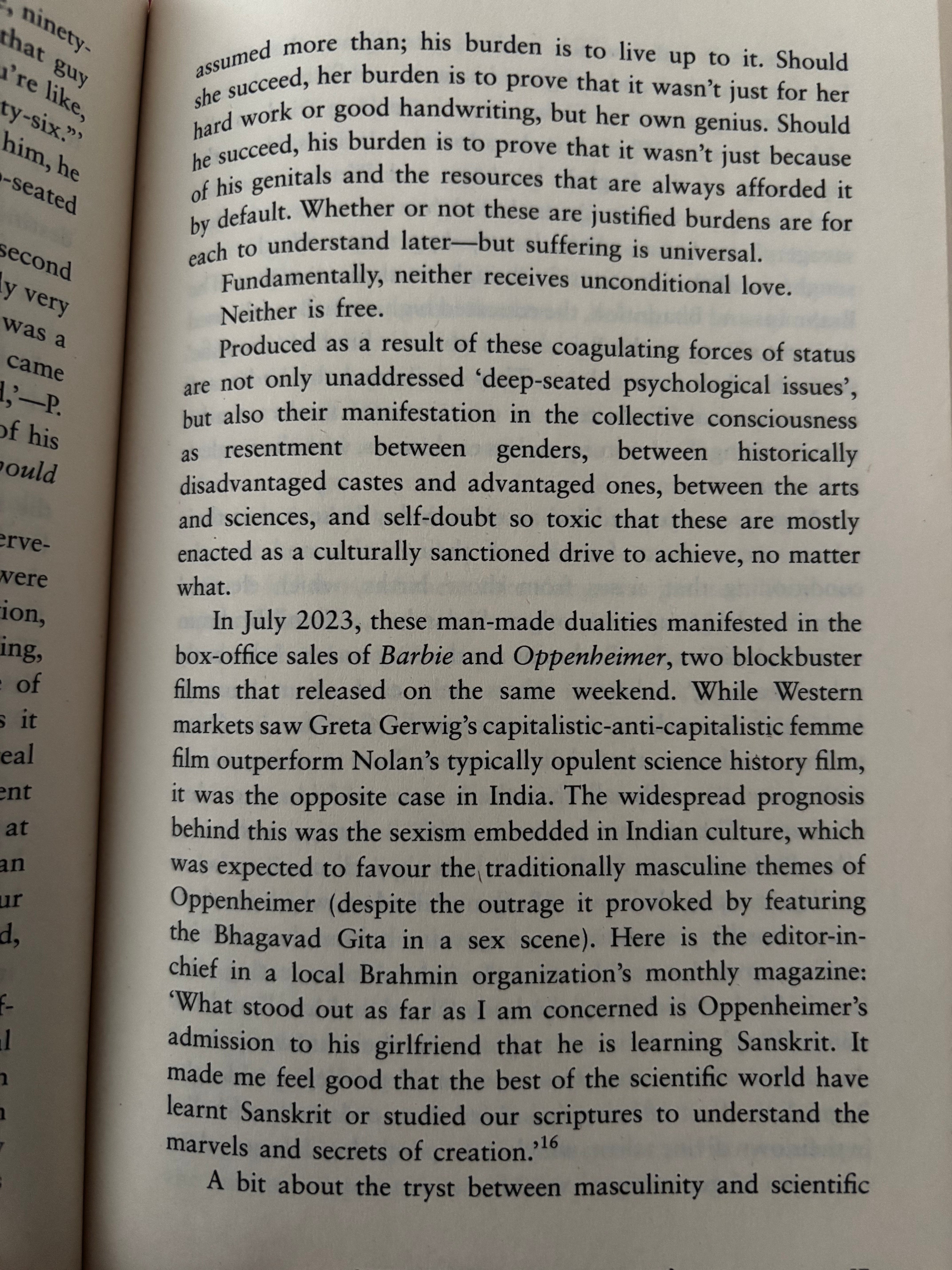
This is the natural response to the fetishization of intelligence within the average Indian household—obvious when you examine its methods. I can speak to the Brahmin procedure, but the principle is psychological and so fairly universal.
The process involves a rejection of the self that does not produce results catering to the narrowly defined idea of intelligence respected by culture. Instead, it induces the making of the ideal Pavlovian-self, for rewards like acceptance, appreciation, love, which all followed prestige. It’s all best captured by one Hindi word: aukaat.
Ghar pe bhi aukaat honi chahiye. Even at home you have to have status.
One respectable offshoot of the great Indian dream is to move abroad and realize the great American Dream. Family members may be compared to see who is doing how well. “My two elder sons are employed in the US— one works for Infosys and the other General Electric… My youngest son is a journalist here in Bengaluru.”
“What—journalism, is it?” the father is pained to hear from friends and relatives. ‘It is a way of saying, “Oh, a calamity has struck!’’’
Tamil Brahmins are told from a young age that they have to be good at studies. Simple living, high thinking: that was the motto. There were many examples used to prove the Brahmins’ claims to God-given talent. Srinivas Ramanujan, Shakuntala Devi, Aryabhatta, Bhaskara, Charaka, J.C. Bose, C.V. Raman, and other Brahmins held up as evidence of the special ‘Indian knack’ for science and mathematics.
Social and moral values are also transferred through this attitude to education and intelligence. “A lot of people in the family used to keep saying that, you know, we’ve got nothing else. There are no family riches. All we’ve got to give you is an education.”
And as for math? “You don’t come home with anything short of a hundred.”
More on the gendered, casteist ideas of success and intelligence that Indians grow up with in Chapter 2 of Famous Last Questions. In case you haven’t yet, please read and leave a review on Amazon and Goodreads.
mad words is a reader-supported publication. To receive new posts and support my work, consider becoming a free or paid subscriber.